FP8:Horizon 2020- 3 Pillars of Horizon 2020
- EIT and Knowledge- and Innovation Centres
- Simplification
- Next Steps
FP8: Horizon 2020
The next Framework Programme will not be called FP 8 but rather Horizon 2020.
Horizon 2020 is the financial instrument implementing the Innovation Union, a Europe 2020 flagship initiative aimed at securing Europe's global competitiveness. Running from 2014 to 2020 with an €80 billion budget, the EU’s new programme for research and innovation is part of the drive to create new growth and jobs in Europe.
Horizon 2020 provides major simplification through a single set of rules. It will combine all research and innovation funding currently provided through the Framework Programmes for Research and Technical Development, the innovation related activities of the Competitiveness and Innovation Framework Programme (CIP) and the European Institute of Innovation and Technology (EIT).
3 Pillars of Horizon 2020:
Horizon 2020 is built on three pillars:
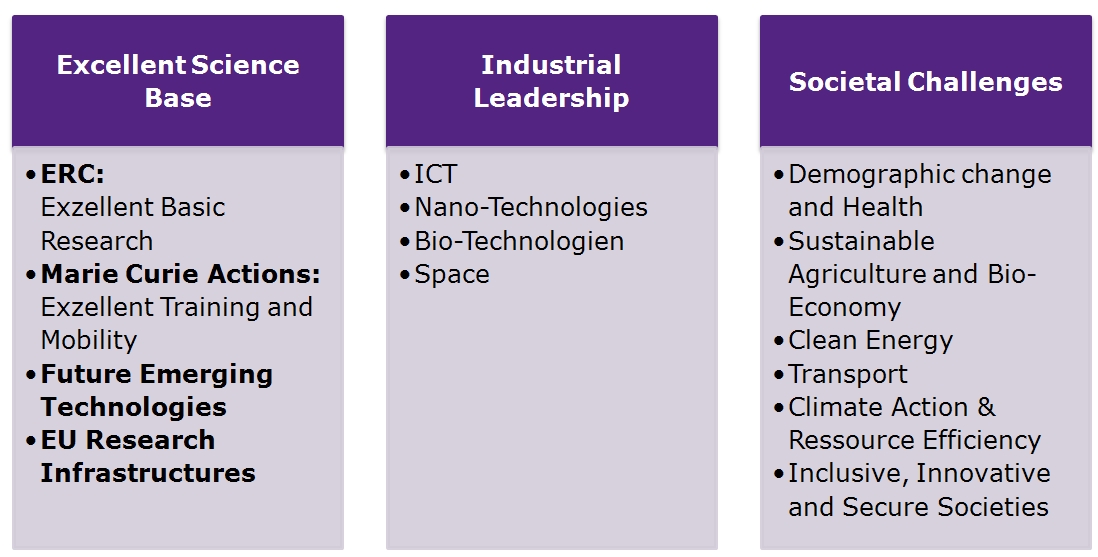
Excellent Science base
The first pillar includes instruments, that were also part of FP7. The funding of Marie Curie Actions and of the ERC will increase. Future and Emerging Technologies are currently part of the Cooperation Topic "ICT" and Science Infrastructures are currently funded under Capacities.
Goal of the pillar: Strengthening of Europe's Basic Research
Industrial leadership
Also the second pillar includes topics that were already part of PF7 but in the next framework the main focus here will be market oriented. The goal are innovations, which shall strengthen Europe's position versus competitors such as the USA, China and Japan. This pillar will include new funding instruments such as prices for innovations, access to risk finance and pre-commercial procurement. In this pillar research organisations will be rather subcontractors than project partners.
Goal of this pillar: More (private) investment in research and innovation
Societal Challenges
These challenges mirror the Europe 2020 Strategy of the European Commission. Whereas the 7th framework funded research disciplines, Horizon 2020 will rather fund the answering of specific research questions inside these 6 challenges. Social sciences and economics are horizontal topics and will be part of all these challenges and in particular of the sixth "Inclusive, innovative and secure societies".
Goal of this pillar: Research on Europe's Grand Challenges
EIT und Knowledge- and Innovation Centres
The European Institute of Innovation and Technology (EIT) will be part of Horizon 2020, whereas today it is not integrated in FP7. It is the goal of the EIT to facilitate the cooperation between educational/research organisations and the industry. This cooperation shall lead to the entrepreneurs of the future. In the next funding period the commission will enlarge the funding of the EIT dramatically. The funding will increase from 309 million since 2008 to 3.200 millions from 2014 to 2020.
The EIT is based on transnational public-private partnerships, known as Knowledge- and Innovation Centres (KIC). Currently there are three KICs running: "KIC InnoEnergy" on sustainable Energy, "Climate KIC" and the "EIT ICT Labs" dealing with ICT and problems of today's communication society. Between 2014 and 2020 six new KICs will be founded whose topics will be related to the six societal challenges of the third pillar of Horizon 2020.
Simplification
It seems that Horizon 2020 will really make a big step towards simplification. A progress that the commission promised for several years. The most important rules are summarized in the following list:
- simplification of time-recording by providing a clear and simple set of minimum conditions
- in particular abolition of time-recording obligations for staff working exclusively on a Horizon 2020 project
- and one fixed number of productive hours defined in the Grant Agreement - indirect costs covered by a single flat-rate applied to the direct costs as a general rule (20% for most of the projects)
- one single reimbursement rate for all participants and activities in the same project (100% for most of the projects)
- a simpler reimbursement of direct costs, with a broader acceptance of beneficiaries' usual accounting practices;
Next Steps
From 30/11.2011: Parliament and Council negotiations on the basis of the Commission proposals
Ongoing: Parliament and Council negotiations on EU budget 2014-20 (including overall budget for Horizon 2020)
Mid 2012: Final calls under 7th Framework Programme for Research to bridge gap towards Horizon 2020
By end 2013: Adoption of legislative acts by Parliament and Council on Horizon 2020
1/1/2014: Horizon 2020 starts; first calls of Horizon 2020 may be launched by the end of 2013